PAP classification and Bethesda equivalents, ÖGZ 2005, Breitenecker et al. Gyn Aktiv 3:16-20, 2005. PAP III (ASC‑US, ASC‑H), PAP IIID (LSIL, HSIL)
Let's get
biophysical
About adsorbing pathogens, high-risk HPV clearance and how to prevent oncogenic transformation of cervical lesions
Research and Development of DeflaGyn® vaginal gel
At the end of the millennium, the antioxidant properties of plant and mineral substances began to be studied more intensively. In collaboration with a German research team, a way was found to improve the usually low antioxidant capacity of selenite by mixing it with selective organic acids.
It was verified that selenium (as selenite or selenate) is converted to selenoproteins in the human body, for example:
- glutathione peroxidase (mitochondria, intestinal cells, spermatozoa)
- thioredoxin reductase (cell growth)
- deiodination (thyroxine ➜ triiodothyronine)
Therefore, selenium is an essential trace element for the organism.
It was not previously known that selenite in vitro in an acidic environment gains very powerful antioxidant properties. This method lowered the reducing potential from +366mV to –740mV, significantly increasing anti-inflammatory effects.
Further in vitro tests confirmed the high antioxidant potential of this mixture, which was later named DEFLAMIN®.
It is worth noting that these effects are more powerful when used locally. In systemic applications, the effect is reduced due to the increase in body pH (pH = 7.2 – 7.4).
Standard redox potentials of some nutrients ®
| E₀ (VOLT) | SYSTEM |
|---|---|
| + 0.82 | O₂ / H₂O |
| + 0.366 (alkaline environment) | Selenite |
| + 0.300 | Tokoferol (Vitamina E) |
| + 0.100 | Ubiquinone (Koenzima Q₁₀) |
| + 0.08 | Acidi askorbik (Vitamina C) |
| + 0 (nga +0.16 në –0.02 V) | Flavonoide |
| – 0.12 | Riboflavin (Vitamina B2) |
| – 0.22 | Cistine / cisteinë |
| – 0.23 | G SH / GSSG |
| – 0.29 | Acid tiotik (acid alfa lipoik) |
| – 0.32 | NADH + H⁺ / NAD⁺ |
| – 0.740 (acidic environment) | Selenite |
Note: Redox values in volts for important substances have been measured relative to hydrogen electrodes. The movement of electrons from plus to minus forms a voltage-dependent cascade. Tocopherol (Vitamin E) as a free radical scavenger would be positioned above coenzyme Q₁₀ and would be restored by it, and so on.
N. Fuchs, Mit Nährstoffen heilen, 4. Auflage, 2012.
Silicon Dioxide (SiO₂)
Silicon dioxide has been known as an inactive component in pharmaceutical and cosmetic applications for decades. Due to its inertness, it has negligible toxicity.
Another feature is its high adsorptive capacity, which depends on particle size – the smaller the particles, the greater the adsorptive capacity.
Two characteristics, chemical inertness and adsorptive properties, make silicon dioxide an interesting active component with a high benefit-risk ratio for many applications.
Silicon dioxide is often used in drops, gels or ointments for adsorbing and binding bacteria, fungi and viruses. No pharmacological, metabolic or immune properties are described for it.
DeflaGyn® vaginal gel – Mechanism of Action
The mechanism of action is based on the adsorptive properties of SiO₂ as well as the antioxidative effect of the DEFLAMIN® compound (sodium selenite and citric acid).
The adsorption of viruses on surfaces or particles is influenced by various biochemical and biophysical parameters and is the subject of intensive scientific research.
Many publications have confirmed the adsorptive binding of proteins, lipids, viruses and bacteria by silicon dioxide.
Murray JP, Laband SJ. Degradation of poliovirus by adsorption on inorganic surfaces. Appl Environ Microbiol. (1979) 37:480–6. doi:10.1128/AEM.37.3.480-486.1979
Barrett EG, Johnston C, Oberdörster G, Finkelstein JN. Silica binds serum proteins resulting in a shift of the dose-response for silica-induced chemokine expression in an alveolar type II cell line. Toxicol Appl Pharmacol. (1999) 161:111–22. doi:10.1006/taap.1999.8793
Pathogen Neutralization (Antioxidative Effect – Anti-inflammatory)
The aim of the analysis was to evaluate the antioxidant capacity of DeflaGyn® product. To measure this capacity, the ORAC method (oxygen radical absorbance capacity), standardized by Prior et al. 2005 and widely used in the food and cosmetic industry, was used.
This series of tests shows that DEFLAMIN® or the mixture of sodium selenite and citric acid contributes to the antioxidant effect of the product. This is consistent with the data of Albrecht et al. (1999), who demonstrated the antioxidant activity of sodium selenite under physiological conditions.
Evaluating of the antioxidant capacity of the product „VaginalgEl“. Dr. Zimmermann, Institute Prof. Kurz (2013).
Albrecht, S., Zimmermann, T., Grützmacher, R. et al. Zum redoxsensitiven Verhalten von Selenit in Gegenwart reaktiver Sauerstoffspezies. Med Klin 94, 70–73 (1999). https://doi.org/10.1007/BF03042197
Antioxidative Capacity of DEFLAMIN®

The antioxidative capacity of DEFLAMIN® (a globally patented formula) is higher than that of its individual components and even stronger than that of vitamin C.
Oxidative stress caused by infections and inflammation plays an important role in DNA damage and the development of cervical tumors. Studies suggest that this stress affects the integration of HPV DNA – a key step in the malignant transformation of cervical epithelium.
Oxygen Radical Absorbance Capacity (ORAC): When measured, vitamin E derivative (Trolox) is used as reference, therefore the result is given in Trolox Equivalents (TE) units.
Clinical Development
To verify the effectiveness of DeflaGyn® vaginal gel, a study was first conducted in Austria (Huber J et al. 2016).
The clearance rate (improvement of findings) of untreated patients was compared with the clearance rate of patients treated with DeflaGyn® vaginal gel during an observation period of 3-4 months.
In 77% of patients with baseline PAP III (ASC-US, ASC-H) and in 71% of patients with baseline PAP IIID (LSIL, HSIL), improvement occurred after treatment with DeflaGyn® vaginal gel after 3-4 months (PAP II).
The results of another multicenter, randomized, open-label study on the therapeutic efficacy of DeflaGyn® vaginal gel medical device on cervical lesions have confirmed, and even more so, these results (Major AL et al. 2020).
With comparable rates of remission and regression (72.2%), as already described, the antiviral effect on high-risk HPV (hr-HPV clearance 54%) and beyond this a highly significant reduction in the oncogenic risk of transformed cells (p16/Ki-67 negativity 83%) can be demonstrated.
Huber J et al.

Univ. Prof. DDr. Johannes C. Huber, Medical University of Vienna, University Clinic for Gynecology, Clinical Department for Gynecological Endocrinology and Reproductive Medicine
Routine treatment of cervical cytological cell changes
Diagnostic standard, prevention and routine treatment of preventive cervical diseases and cytological diseases. Routine treatment data in the context of anonymous data collection from practicing gynecologists; an academic, non-interventional study
Principal investigators
J. Huber, B. Pötsch, M. Gantschacher, M. Templ
Gynecological application of DEFLAMIN® highly dispersed SiO2 as DeflaGyn® vaginal gel
Project carried out by the academic, independent study network ANISNet (Academic Non-Interventional Study Net) of the Austrian University.
Result
DeflaGyn® vaginal gel significantly improves regression of PAPII & PAP IIID
Diagnosis and treatment of cytological changes in vaginal and cervical cells are described in European and national guidelines. The aim of this data collection was to evaluate the clearance rates of cytological findings PAP III and PAP IIID in patients over a 3-4 month period.
A new treatment option has been used in gynecological practice for patients with PAP III and PAP IIID findings between confirmation and successful follow-up.
Major AL et al.

Univ. Prof. DDDr. Attila L. Major, Department of Obstetrics & Gynecology, Cantonal Hospital of Fribourg, Switzerland, Chief Physician at Femina Gynecological Center, Geneva, Switzerland
Clinical follow-up after treatment
Efficacy and safety of an adsorptive and antioxidative vaginal gel, high-risk HPV in CIN1 and p16/Ki‑67: a randomized controlled trial
Principal investigators
A. Major, V. Dvořák, A. Skřivánek, T. Malík, M. Pluta
Gynecological application of DeflaGyn® vaginal gel
The effect of DeflaGyn® Cervical intraepithelial neoplasia type 2 (CIN2) as well as p16-positive CIN1 and the presence of the onco-marker p16 were investigated.
Primary endpoint of result
-
Endpoint: Cytological or histological regression after 3 months
-
Result: 72.2% Active arm versus 25.0% Control arm (p<0.001)
Secondary endpoints of result
-
Significant cytological regression after 3 months
-
Sustainability of cytological regression after 6 months
-
Significant clearance of oncogenic HPV strains after 3 months
-
Significant decrease in CINtec® PLUS positivity after 3 and 6 months
This possible, open, two-armed, controlled, multicenter trial comparing the efficacy of DeflaGyn® vaginal gel with an untreated control arm showed that the DeflaGyn® vaginal gel medical device is effective for increasing regression and preventing their progression.
The significant change in p16/Ki‑67 shows that DeflaGyn® vaginal gel is fundamentally affecting oncogenic progression, indicating that DeflaGyn® vaginal gel is a potential therapy regimen for patients with HPV-infected HPV
Cytology – BD SurePath™; HPV – cobas® 4800; p16/Ki‑67 – CINtec® PLUS
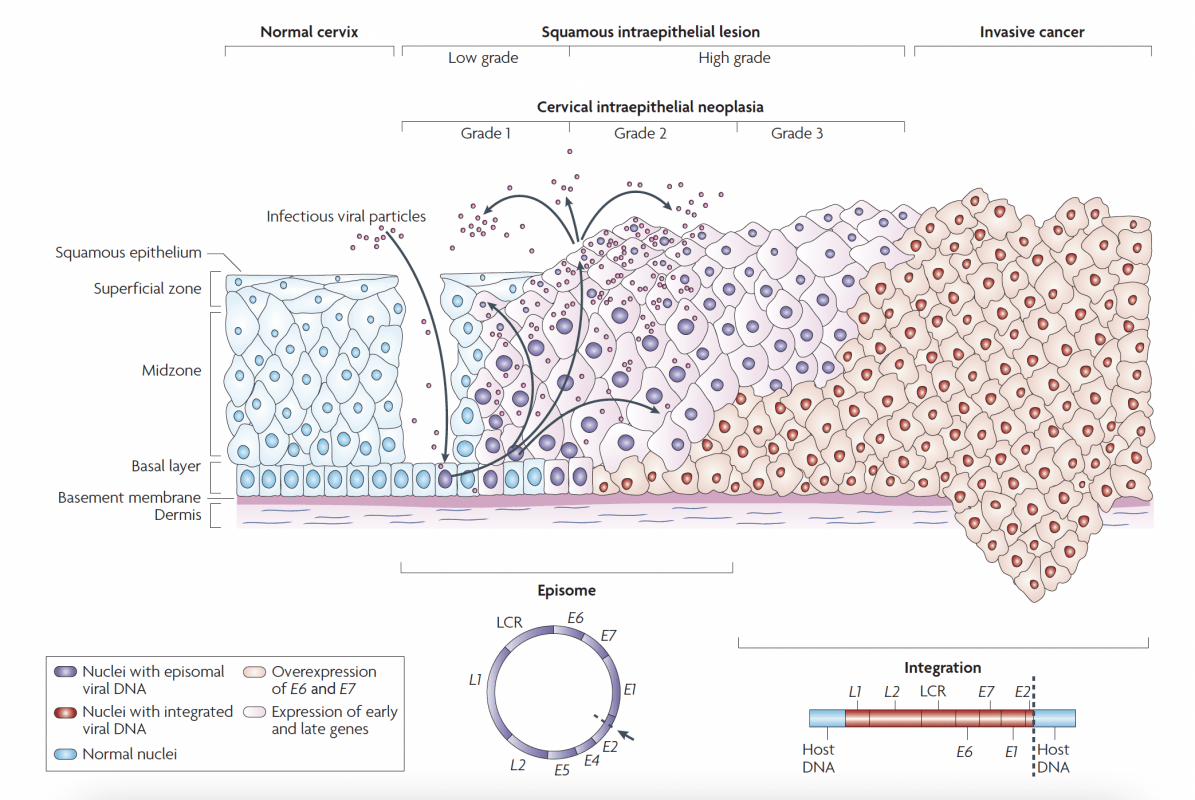
HPV Life Cycle
p16 plays an important role in regulating cell division. When p16 is expressed, a protein complex is formed by the retinoblastoma protein (pRb) and the transcription factor (E2F), which initiates the arrest of the cell cycle.
This means that p16 has an anti-proliferative effect under physiological conditions. In oncogenically transformed cells, after oncogenic transformation by high-risk HPV, the antiproliferative effect of p16 is abolished.
This leads to uncontrolled cell division, genetic instability and, at the same time, overexpression of p16.
After reproduction by host cells, infectious viral particles are released from cervical epithelial cells. Therefore, viral particles can be found in vaginal secretions.